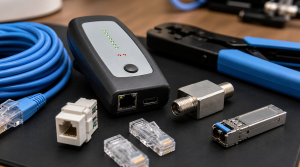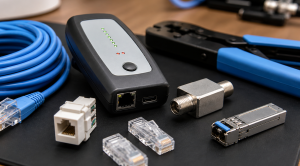
Cat6 vs Cat6A in 2026: What to Run, What to Avoid, and When Fiber Makes Sense
 Tech Guru
In-wall cabling is one of the few homelab decisions that can be painful to redo for a decade. The fastest-looking label on the box is not automatically the best choice. You want reliable performance, a code-appropriate jacket rating, clean terminations, Power over Ethernet (PoE) headroom, and a path you can test.
Telecommunications Industry Association (TIA) cabling standards and Ethernet specs such as the Institute of Electrical and Electronics Engineers (IEEE) 802.3bz specification provide the technical backdrop. For homes, the takeaway is simpler: run solid copper cable, avoid marketing-only categories, and use fiber when distance, isolation, or rack backbones justify it.
Design principle: For new permanent copper runs, Cat6A is the safe long-term choice when budget and bend radius allow; Cat6 is still excellent for many shorter home runs.
The Decision
| Cable | Best Fit | Avoid |
|---|---|---|
| Cat6 | Cost-sensitive home runs, 1G or 2.5G links, and shorter 10G experiments. | You expect guaranteed full-length 10GBASE-T everywhere. |
| Cat6A | New permanent runs where 10GBASE-T might matter. | Tight bends, tiny boxes, or poor termination discipline. |
| DAC | Short rack-to-rack or switch-to-server Small Form-factor Pluggable Plus (SFP+) links. | In-wall runs. |
| Multimode fiber | Short optical rack and backbone links. | Mixing optics and cable types randomly. |
| Single-mode fiber | Long runs, detached buildings, and future backbone links. | Poor cleaning, rough handling, or mismatched optics. |
For a beginner, the important distinction is between a permanent link and a patch cord. A permanent link is the solid-conductor cable inside the wall plus its terminated jacks. Patch cords are flexible, stranded cables used from a device to a wall jack or from a patch panel to a switch. Do not use a bag of long patch cords as permanent structured cabling.
Cat6 supports 1000BASE-T across the normal 100-meter Ethernet channel and is the practical baseline for 2.5GBASE-T and 5GBASE-T upgrades. Cat6 can carry 10GBASE-T over shorter channels, but the usable distance depends on the installed channel and alien crosstalk. Cat6A is the straightforward choice when the requirement is a standards-compliant 10GBASE-T channel to 100 meters. That extra assurance comes with thicker cable, larger bend radius, more difficult termination, and a higher installed cost.
Advanced Design Tradeoffs
Do not choose cabling from link speed alone. Start with the application, channel length, pathway space, PoE load, electromagnetic environment, and the interfaces on both ends. A short server-to-switch link inside one rack is usually better served by a compatible direct attach copper cable than by 10GBASE-T. A detached-building link benefits from fiber because optical cable does not create a conductive data path between structures. A ceiling access point still needs balanced copper if the same cable must deliver PoE.
Shielded Cat6A can help in a design that actually requires shielding, but the shield, jacks, patch panels, and bonding system must be treated as one engineered channel. Buying shielded cable without a correct bonding plan does not automatically improve a home installation. Unshielded Cat6A is often easier to operate in normal residential pathways.
For high-power PoE, conductor gauge, bundle size, ambient temperature, and cable temperature rating affect heat. The Ethernet Alliance's installation guidance explains why bundle design matters. Do not infer that every cable labeled Cat6A is equally suitable for a dense PoE bundle; review the cable's listing, conductor size, and manufacturer installation data.
What to Avoid
- Copper-clad aluminum cable.
- Flat, ultra-thin cable in walls.
- Mystery Cat7 or Cat8 patch cords for normal home Registered Jack 45 (RJ45) runs.
- Unrated cable in plenum spaces.
- Untested contractor work.
- Running low-voltage cable parallel to power cables for long distances.
Installation Details That Matter
- Use solid copper for in-wall runs and stranded cable for patching.
- Match cable, keystones, and patch panels to the category you install.
- Respect bend radius and do not kink cable.
- Label both ends before installing the wall plate.
- Pull more than one run to important locations.
- Use conduit where possible; it beats guessing the next standard.
Separate communications cabling from mains power as required by the cable listing, equipment instructions, and local code. Use the correct riser, plenum, outdoor, direct-burial, or ultraviolet-resistant jacket for the pathway. Fire stopping and penetrations are code work, not cosmetic details. When a contractor performs the installation, put the category, test method, labeling format, pathway, and delivery of test results in the scope before work starts.
Rollout and Rollback
- Inventory each planned run, endpoint, expected speed, PoE class, and approximate length.
- Build and terminate one representative run before buying all termination hardware. Confirm that the cable, jack, wall box, and patch panel are physically workable.
- Label both ends and record the cable ID, room, patch-panel port, switch port, and test result.
- Wiremap every run. For paid Cat6A work or any link with a contractual performance requirement, require certification results for the applicable permanent-link or channel limit.
- Move one noncritical endpoint, confirm negotiated speed and PoE stability, then migrate the remaining endpoints in batches.
Physical cabling does not have a software-style undo button. Preserve the old live path until the replacement passes, leave pull strings in conduit, keep spare matching jacks, and avoid closing inaccessible walls before testing. If a new link fails, move the endpoint back to the labeled known-good run or temporary patch path, then repair and retest the new permanent link.
When Fiber Makes Sense
Fiber is excellent for detached buildings, long runs over copper limits, electrical isolation between structures, rack backbones, and higher-speed uplinks. It does not carry PoE, so use it where distance and isolation matter, not where you need to power an access point (AP) or camera.
Preterminated fiber reduces field-termination work, but the pathway must protect the connector and respect pulling tension and bend limits. Match the fiber type, connector polish, transceiver wavelength, and Ethernet reach on both ends. A link light only establishes basic connectivity; it does not confirm optical margin, cleanliness, or compatibility under the intended load.
Validation and Evidence
This guide is documentation-backed. TechGeeks did not certify a Cat6 or Cat6A installation, measure alien crosstalk, record optical loss, or load-test a PoE bundle for this revision. The checks below are acceptance steps for the reader or installer, not reported TechGeeks test results.
- Visual inspection: Confirm the jacket printing, listing, conductor material, category, pathway rating, and absence of kinks, crushing, or exposed conductors.
- Wiremap: Verify all eight conductors, pair order, shorts, opens, reversals, and split pairs. A basic wiremap pass does not certify category performance.
- Certification when required: Save the permanent-link or channel report with cable ID, tester calibration state, test limit, length, insertion loss, return loss, near-end crosstalk, and applicable alien-crosstalk results.
- Operational check: Confirm the expected link rate at both ends, inspect interface counters for cyclic redundancy check (CRC) errors and link flaps, and transfer a known file in both directions. Record the negotiated rate; do not describe internet speed as a cable certification result.
- PoE check: Confirm the powered device receives the required class, remains stable under its real workload, and does not repeatedly renegotiate or reboot.
- Fiber check: Clean and inspect connectors with appropriate tools, confirm matched optics, and review digital optical monitoring or measured loss where the transceivers and acceptance plan support it.
Failure Patterns and Troubleshooting
A link that negotiates at 100 megabits per second instead of 1 gigabit often points to an open, damaged, or mis-terminated pair because 1000BASE-T needs all four pairs. A 10-gigabit link that flaps under sustained traffic may involve channel length, poor termination, excessive untwist, crosstalk, or incompatible electronics. Intermittent PoE resets can indicate power budget, cable resistance, connector damage, or heat rather than an IP configuration problem.
- Replace both patch cords with known-good, correctly rated cords before reopening walls.
- Check switch and endpoint logs, negotiated speed, error counters, and PoE events.
- Test the permanent link independently from patch cords when the tester supports that limit.
- Re-terminate one end at a time, preserving pair twist as close to the termination as the hardware instructions require.
- For fiber, clean before replacing optics and verify wavelength and fiber type on both ends.
What This Evidence Does Not Prove
- A wiremap pass does not prove Cat6 or Cat6A bandwidth, crosstalk margin, or 10GBASE-T compliance.
- A successful file transfer does not prove the channel will remain error-free at full load, maximum temperature, or maximum PoE power.
- A Cat6A label does not prove the cable is solid copper, code-appropriate, correctly terminated, or authentic.
- A link light on fiber does not prove adequate optical margin or that the selected optics are supported by the switches.
- This documentation review does not establish that a proposed pathway complies with local electrical, fire, tenancy, historic-building, or permit requirements.
Useful Gear and Buyer Notes
Affiliate disclosure: As an Amazon Associate, TechGeeks may earn from qualifying purchases. The product links below are buying references, not a requirement to buy a specific brand or seller. Verify compatibility, seller quality, warranty, and current specs before ordering.
| Need | Good Choice | Why It Fits | Affiliate Link |
|---|---|---|---|
| Permanent copper | Solid copper Cat6A or Cat6 bulk cable | Use solid copper cable, not CCA or mystery marketplace cable. | Amazon: solid copper Cat6A bulk cable |
| Terminations | Keystones and a patch panel | Clean terminations are as important as the cable. | Amazon: Cat6A keystone patch panel |
| Testing | Wiremap tester | Every permanent run should be tested. | Amazon: Klein LAN Scout Jr. cable tester |
| Rack uplink | SFP+ DAC cable | Simple, inexpensive, low-latency short 10 Gigabit Ethernet (10GbE) links. | Amazon: SFP+ DAC cable 10G |
| Fiber path | Optical Multimode 4 (OM4) or Optical Single-mode 2 (OS2) fiber patch cables | Useful for lab backbones and longer optical runs. | Amazon: OM4 OS2 fiber patch cable |
Common Mistakes
- Buying CCA because it is cheap.
- Assuming Cat8 marketing helps a normal home wall jack.
- Ignoring PoE heat and bundle size.
- Failing to label both ends.
- Installing one cable where two would have been easy.
Security, Privacy, Legal, and Recovery Boundaries
- Security: A standards-compliant cable provides transport, not authentication or segmentation. Physical access to an active wall jack can still become network access; disable unused ports and enforce appropriate network policy.
- Privacy: Labels and diagrams can reveal room names, device roles, management locations, and camera paths. Restrict detailed as-built records while keeping a recovery copy available to authorized operators.
- Legal: Cable jacket ratings, separation, penetrations, fire stopping, grounding, and work in rental or shared spaces are governed by local rules and the authority having jurisdiction. This guide is not a code approval.
- Recovery: Keep the prior path until acceptance, retain test reports and port maps, store spare compatible terminations, and document a temporary patch route for critical endpoints.
Related TechGeeks
- Cat5e vs Cat6 vs Cat6A: What To Buy and What To Avoid
- Single-Mode vs Multi-Mode Fiber: Which One Should You Run?
- PoE vs PoE+ vs PoE++: Why Cameras and APs Reboot
- My Ubiquiti UniFi Home Network: Business-Grade Networking at Home
References
- TIA: ANSI/TIA-568.2-E and ANSI/TIA-568.5-1 announcement
- IEEE 802.3bz Task Force
- Ethernet Alliance: Overview of IEEE 802.3bt PoE
- Ethernet Alliance: Cabling-system design for PoE
- Fluke Networks: Cable testing and crosstalk
- CCCA: Risks of non-compliant communications cable and CCA conductors
Final Thought
Cable is infrastructure. Spend the effort up front on solid copper, clean paths, labeling, and testing. The quiet win is never thinking about that wall run again.
This cabling guide connects the physical layer to the rest of the TechGeeks homelab roadmap: document each run, prove what the installed channel can support, and make speed, PoE, switching, and fiber choices from that evidence.
Need help applying this?
Bring TechGeeks into the real environment.
If you are working through this on a live network, WordPress site, Linux server, AI workflow, or PisoWiFi deployment, send the context and we can help turn it into a practical plan.