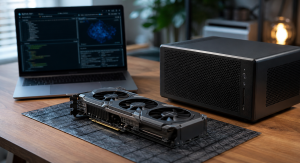
Home AI Hardware Levels: A Beginner's Guide to the PC You Need
 Tech Guru
Quick Answer
Try a small local model on your current computer before buying hardware. Size an upgrade for the exact model artifact, context, simultaneous users, and other GPU jobs, then compare measured quality and latency. The tiers and interactive selectors below are planning estimates, not tested builds or guarantees that a named model will fit.
Interactive Hardware Tier Selector
Pick what you want to do. The selector shows the hardware level that usually fits that goal.
Choose a box above to see the matching hardware tier.
Do you need a new PC? Can you use an old desktop? Is 8GB of VRAM enough? Why do people keep talking about RTX 3090s, RTX 4090s, and workstation GPUs? And what happens if the same box also runs Plex, Jellyfin, Frigate, or Tdarr?
This is the hardware decision guide in the TechGeeks home AI series. Use it before an Ollama install guide, Open WebUI setup, model-picking post, or RAG/document workflow build. It helps you decide what class of PC makes sense before you spend money.
You do not need to understand every acronym before you start. The goal is not to chase the biggest system possible. The goal is to pick the level that matches what you actually want to do.
Start Here: The Fast Answer
Use this table to shortlist a test configuration, not as a shopping specification. CPU, memory, power-supply, and storage figures below are illustrative budgets; verify the exact card and system requirements before ordering parts.
| If you want to... | Start here |
|---|---|
| I just want to learn local AI | Use your current PC first |
| I want a private ChatGPT-style web page at home | Use Ollama plus Open WebUI on a small server or desktop |
| I want local AI to feel useful every day | Use a desktop with a 12GB to 16GB NVIDIA GPU |
| I want coding help and document chat | Aim for a 16GB to 24GB GPU |
| I want a serious one-GPU AI homelab | Aim for a 24GB GPU |
| I want to run 31B-class models | Start looking at 32GB+ VRAM |
| I want large models, many users, or lots of headroom | Look at 48GB+ workstation hardware or hosted inference |
The beginner mistake is buying hardware before you know what you want to run. If you are unsure, start one level lower than your first instinct suggests. A week of real usage will tell you whether you need more speed, more VRAM, more system RAM, or a separate box.
Current Runtime Context: July 15, 2026
Exact fit depends on the model build, quantization, context length, KV-cache format, runtime, operating system, and other workloads. Ollama documents hardware-dependent context defaults, but verify the loaded allocation with ollama ps. Increasing context consumes additional memory; a model download's file size is not its complete running memory budget.
NVIDIA remains the conservative compatibility choice for many local-AI tools, but it is no longer the only practical path. Ollama 0.30 enabled its GGUF/Vulkan engine by default across more AMD, Intel, and NVIDIA hardware, while Ollama's MLX work targets Apple silicon. Those announcements establish supported execution paths, not equal speed or feature parity on every device. An advertised NPU TOPS number is also irrelevant unless the exact runtime and model actually use that NPU. Recheck the Ollama hardware matrix, model tag, and driver requirements against the installed release and again before buying.
Plain English: VRAM Is the First Bottleneck
Interactive Model-to-Hardware Recommender
Select the model classes and workloads you want to run. The result gives a practical starter hardware tier.
Choose one or more model/workload boxes above.
VRAM Ladder: What Each Tier Feels Like
More VRAM usually means larger models, more context, or more headroom for other services.
Reminder: VRAM does not automatically guarantee speed or quality. Quantization, context length, and background workloads still matter.
For home AI, the most important spec is usually GPU VRAM, which means the memory on the graphics card. On a normal desktop with a separate NVIDIA or AMD card, VRAM is separate from normal system RAM. Some systems, such as Apple Silicon Macs and some integrated-GPU setups, use shared or unified memory instead, so read their memory specs a little differently.
System RAM, CPU, and storage matter, but if you want local AI models to feel good, VRAM is usually the first bottleneck because the model has to fit in memory before it can run well.
Think of VRAM like desk space. If the model is a big paper map, VRAM is the desk. A bigger desk lets you open a bigger map and keep more notes beside it. If the desk is too small, you can still try to work, but everything gets slower and more awkward.
VRAM is not a guarantee that every model in a named size class will run well. Quantization, context length, concurrent users, and background GPU work all change memory use. Still, VRAM is the easiest hardware number for beginners to use when comparing systems.
Think of it this way:
| Part | Plain-English role |
|---|---|
| GPU VRAM | Decides which models fit and how much context you can use comfortably |
| GPU compute | Decides how fast tokens generate when the model is running on the GPU |
| System RAM | Normal computer memory; helps when some model work spills over from the GPU to the CPU and keeps the server stable |
| CPU | Handles the operating system, Docker containers, background services, and model work that falls back to the CPU |
| NVMe storage | Fast SSD storage for models, containers, databases, documents, and indexes |
| PSU/cooling | Power supply and cooling; keeps the system stable under long AI and media workloads |
A token is a small chunk of text that the model reads or writes. Context is the amount of text the model can keep in mind at once. When you see model sizes like 3B, 8B, or 31B, the B means billion parameters, which is a rough measure of model size. An agent is an AI workflow that takes multiple steps or uses tools instead of just answering one chat message. Bigger models can be more capable, but they need more VRAM and are not always the right first step.
If you are just starting, do not buy hardware yet. Install Ollama and try a small model first. That will teach you more than a spec sheet will.
Beginner Vocabulary
These are the terms you will see over and over when setting up home AI.
| Term | Plain-English meaning |
|---|---|
| Model | The AI brain you download and run, such as Gemma, Llama, or Qwen |
| Ollama | The local service that downloads models and runs them on your computer |
| Open WebUI | A browser-based chat interface for Ollama and other AI providers |
| VRAM | Memory on the graphics card; the biggest hardware limit for local AI |
| RAM | Normal computer memory used by the operating system and apps |
| Context | How much text the AI can pay attention to in one request |
| Quantization | A smaller version of a model that uses less memory, usually with some tradeoff |
| RAG | A setup where the AI searches your documents before answering |
| Agent | An AI workflow that can take multiple steps or use tools |
| Hosted inference | Running the model on someone else's GPU server instead of your own PC |
Hardware Level 0: Existing PC
This is the "try it before spending money" level. It is the best place to learn the tools before buying parts.
In normal language: this is the "I want to see what local AI is about" setup. It may be slow, but it teaches you the workflow with almost no risk.
Typical specs:
| Component | Typical range |
|---|---|
| CPU | Any reasonably modern Intel/AMD desktop or laptop CPU |
| RAM | 8GB to 16GB |
| GPU | Integrated graphics or older GPU |
| Storage | 100GB+ free space |
Integrated graphics means the GPU is built into the computer instead of being a separate graphics card. It usually shares system memory and is much slower for AI than a dedicated NVIDIA GPU.
Good for:
- Learning Ollama
- Trying Open WebUI
- Running very small models
- Testing prompts, which are the instructions you give the model
- Learning what local AI feels like
Not good for:
- Large models
- Fast coding assistants
- Long-context agents
- Multiple users
- Running AI while also doing heavy media transcoding
Suggested models:
ollama pull llama3.2:1b
ollama pull llama3.2:3b
These are small-model examples for learning the workflow. They are not meant to represent the best possible local AI experience.
What to expect:
Small models may run, but they may be slow. If there is no real GPU acceleration, meaning the graphics card is not doing the AI work, the CPU will do most of the work. On an 8GB RAM system, start with 1B or 3B text models. Gemma 4 E2B can be useful on more capable older PCs, but its current Ollama tag is larger than the name suggests, so treat it as a step up from the smallest starter models.
Hardware Level 1: Mini PC or Low-Power Server
This level is for people who want a quiet, always-on AI test box. Think of it as a small server that can host the web interface and light workloads.
In normal language: this can be a good little control center for Open WebUI, but it usually is not the machine you buy for big models.
Typical specs:
| Component | Recommended target |
|---|---|
| CPU | Modern Intel Core, AMD Ryzen, or similar mini PC CPU |
| RAM | 16GB to 32GB |
| GPU | Integrated GPU |
| Storage | 1TB NVMe preferred |
Good for:
- Open WebUI frontend
- Lightweight local chat
- Document experiments using small models
- Running a central Ollama server for tiny models
- Learning Docker and reverse proxy basics
Not good for:
- Big coding models
- 12B+ models at a good speed
- 31B-class models
- Serious multi-user AI
Recommended use:
Use the mini PC as the web UI and services box, not necessarily as the heavy model box. Open WebUI is the browser interface you use to chat with models. Ollama is the service that downloads and runs those models. Later in the series, this is the kind of machine that can point Open WebUI to a bigger GPU desktop or a hosted provider, which is a cloud service that runs models somewhere else.
Hardware Level 2: Starter GPU Desktop, 8GB to 12GB VRAM
This tier adds dedicated GPU capacity for small-model comparisons. Whether it is useful depends on the answers and response times your workload requires.
In normal language: this is the first real local AI desktop tier. It is good for learning and daily light use, but you should stay with smaller models.
Typical specs:
| Component | Recommended target |
|---|---|
| CPU | 6-core or 8-core desktop CPU |
| RAM | 32GB |
| GPU | NVIDIA GPU with 8GB to 12GB of VRAM |
| Storage | 1TB to 2TB NVMe |
| PSU | Quality 550W to 750W depending on the GPU |
Good for:
- Gemma 4 E2B, with Gemma 4 E4B better suited to 12GB cards and modest context
- Llama 3B/8B-class models
- Small coding models
- Open WebUI with one or two users
- Learning RAG with small document sets
RAG means retrieval-augmented generation. In plain English, the system searches your documents first and then gives the relevant pieces to the AI model so it can answer with that extra context.
Not good for:
- 26B/31B-class models
- Long-context agents
- Heavy coding agents
- AI and heavy Tdarr jobs at the same time
Beginner model choices:
ollama pull llama3.2:3b
ollama pull gemma4:e2b
ollama pull qwen2.5-coder:7b
Practical advice:
An 8GB GPU can be useful, but it is tight. Use smaller models, lower context, and check ollama ps to confirm whether the model is fully on the GPU or split between the CPU and GPU. A 12GB GPU gives you much more breathing room for small and medium models, including trying gemma4:e4b, especially if you want longer prompts or a web UI running at the same time.
Model examples age quickly. If a newer coding model is available in Ollama by the time you read this, use the same hardware logic rather than treating the exact tag above as permanent. Smaller current coding models are the starter tier; larger coding tags such as 30B-class models belong on higher-VRAM systems.
Hardware Level 3: Comfortable Home AI Box, 16GB VRAM
This is the sweet spot for many homelab users. It is still a normal desktop-class build, but with enough memory and GPU capacity to feel practical.
In normal language: this is where local AI starts feeling less like a science project and more like a useful tool.
Typical specs:
| Component | Recommended target |
|---|---|
| CPU | Ryzen 7 / Core i7 class or better |
| RAM | 64GB |
| GPU | 16GB VRAM |
| Storage | 2TB NVMe |
| PSU | Quality 750W to 850W |
Good for:
- Better small/medium models
- Coding assistants with scoped tasks, such as editing one project or solving a specific bug
- Open WebUI for a family or small team
- RAG with a reasonable document set
- Running AI while the server also does light background work
Not ideal for:
- 31B models without compromises
- Many users at once
- Long autonomous agents
- Heavy media transcoding at the same time
What this feels like:
Compare chat, coding, and document tasks separately. A 16GB card provides a memory budget, not an assurance that every task will meet its quality or latency target.
Hardware Level 4: Serious Single-GPU Homelab, 24GB VRAM
This is where local AI gets much more capable, especially if you want one powerful GPU instead of a rack of lab hardware.
In normal language: this is the "I am serious about this" level for one GPU.
Typical specs:
| Component | Recommended target |
|---|---|
| CPU | Ryzen 9 / Core i9 / high-end Core Ultra |
| RAM | 64GB to 128GB |
| GPU | 24GB VRAM |
| Storage | 2TB to 4TB NVMe |
| PSU | Quality 850W to 1000W |
Common GPU examples:
| GPU class | Why people like it |
|---|---|
| RTX 3090 24GB | Used-market value and lots of VRAM, but check card condition, power draw, and cooling |
| RTX 4090 24GB | Strong performance and 24GB VRAM, but expensive |
| Used workstation cards | Sometimes good VRAM-per-dollar value, but check power, drivers, and cooling |
The RTX 3090 and RTX 4090 examples have the same nominal 24GB capacity. Do not infer an AI speed ratio from their product names or gaming results; compare the same model, backend, precision, context, and workload.
Good for:
- 12B to 14B models comfortably
- Some 20B-ish quantized models
- Some 26B/31B-class models with limits
- Local coding assistants
- Better RAG and document workflows
- Open WebUI as a serious household or lab service
Important limit:
24GB VRAM is strong, but it is not infinite. It can run many larger quantized models, and some 31B-class tags may fit with low enough context and overhead. Quantized means the model is stored in a smaller format so it uses less memory. Long context, multiple users, and background GPU workloads can still push 24GB over the edge.
Hardware Level 5: 31B-Capable Workstation, 32GB VRAM
This is the target if you want to run 31B-class local models more comfortably. A 31B-class model is much larger than the 7B and 8B models most beginners start with.
In normal language: bigger local models become realistic here, but context length, model format, and other workloads still matter.
Typical specs:
| Component | Recommended target |
|---|---|
| CPU | Ryzen 9, Core Ultra 9, Core i9, or Threadripper |
| RAM | 128GB preferred |
| GPU | 32GB VRAM preferred |
| Storage | 2TB to 4TB NVMe |
| PSU | 1000W to 1200W |
| Cooling | High-airflow case, serious CPU/GPU cooling |
Common GPU example:
- RTX 5090 with 32GB VRAM
NVIDIA lists the RTX 5090 with 32GB of GDDR7 memory. GDDR7 is the type of memory on the graphics card. That capacity makes it a more comfortable consumer-class option for 31B local work than a 24GB card.
For example, Ollama currently lists the local gemma4:31b tag at about 20GB before KV cache and runtime overhead. The point of 32GB VRAM is the extra headroom, not a guarantee that every 31B long-context workflow will fit.
Before buying at this tier, verify the exact card specs, case clearance, power connectors, PSU requirements, and Linux driver support. The GPU may be the headline part, but the platform around it still matters.
Good for:
- 31B-class quantized models
- Larger context than smaller cards
- Better local coding-agent experiments
- More serious RAG and planning workflows
- Running Open WebUI as a real home AI service
Still not magic:
Even 32GB VRAM can be limited by context length, quantization, multiple users, and background GPU work. A 31B model may fit, but fitting is only the first step. It does not mean every long-context workflow will be fast.
Hardware Level 6: Workstation or Small Lab Server, 48GB+ VRAM
This level is for people who are serious about local AI and want room to grow. It is closer to workstation or lab-server territory than a normal gaming PC.
In normal language: this is no longer a casual PC upgrade. This is workstation or lab hardware.
Typical specs:
| Component | Recommended target |
|---|---|
| CPU | Threadripper, Threadripper Pro, Xeon, or EPYC-class platform |
| RAM | 128GB to 256GB+ |
| GPU | 48GB single GPU, or multiple GPUs for supported split/parallel workloads |
| Storage | 4TB+ NVMe plus backup storage |
| PSU | 1200W+ depending on the GPUs |
| Networking | 2.5GbE, 10GbE, or better for lab use |
Common GPU examples:
- NVIDIA RTX 6000 Ada with 48GB ECC VRAM
- NVIDIA RTX PRO 6000 Blackwell-class workstation cards with much larger VRAM budgets, if your budget and platform fit that tier
NVIDIA lists the RTX 6000 Ada with 48GB of ECC GDDR6 memory. ECC means error-correcting memory, which is more common in workstation hardware. That kind of card is expensive, but it gives much more headroom for local AI than typical gaming GPUs.
Do not assume two smaller GPUs automatically behave like one larger VRAM pool. Model splitting depends on the inference stack, the model, and the performance tradeoffs you are willing to accept.
This tier is usually not beginner hardware. Noise, heat, power, rack space, replacement parts, and platform support matter as much as the model size you want to run.
Good for:
- Larger models
- Larger context
- Agent workflows
- Multi-user Open WebUI
- Local development and testing
- More serious RAG datasets
This is overkill for:
- Basic chat
- Learning Ollama
- One user asking simple questions
- A first homelab AI experiment
Hardware Level 7: Use Hosted Inference Instead
Sometimes the right hardware level is "do not buy the hardware." Hosted inference means using someone else's GPU server through a web service or API instead of running every model at home.
In normal language: sometimes it is cheaper to rent the big model only when you need it instead of buying a large GPU that sits idle most of the week.
Hosted inference makes sense when:
- You only use big models occasionally
- You need frontier-size or cloud-only model families
- You need very long context without buying a 48GB+ card
- You need high reliability
- You do not want GPU heat, power draw, and noise
- You are still learning what you actually need
Ollama cloud models are one hybrid option: local tools can keep using the Ollama interface while supported cloud models run remotely instead of running on your GPU.
The best home setup is often hybrid:
| Job | Run locally? |
|---|---|
| Private notes and small chat | Yes |
| Simple coding help | Yes, with the right model |
| Heavy reasoning once in a while | Maybe hosted |
| Huge agents or long context | Often hosted |
| Sensitive internal docs | Prefer local or private infrastructure |
What About Context Length?
Context Length Mini Chart
More VRAM can allow larger default context windows, but actual loaded settings still need to be checked.
ollama ps after loading a model to confirm context and processor placement.Context length is how much text the model can pay attention to at once. More context lets the model consider more of a document, chat, or codebase in one request.
Long context is useful for:
- Large documents
- Coding agents
- Research tasks
- Long chat histories
- Multi-step workflows
But long context costs memory. In the table below, 4K means about 4,000 tokens, 32K means about 32,000 tokens, and 256K means about 256,000 tokens. Ollama's current context length page lists default context levels based on available VRAM:
| VRAM | Ollama default context |
|---|---|
| Under 24GB | 4K context |
| 24GB to under 48GB | 32K context |
| 48GB or more | 256K context |
That is one reason the 24GB, 32GB, and 48GB tiers matter so much, but model size, quantization, KV cache, and other GPU workloads still matter.
Ollama's docs are not perfectly consistent here: the context length page now lists the VRAM-based defaults above, while the FAQ still says the default context window is 4096 tokens when explaining how to override it. Do not assume the number in a table is what your model actually loaded with. Use ollama ps to check processor placement and context after the model is running. Cloud models are set to their maximum context length by default.
What If I Also Run Plex, Jellyfin, Frigate, or Tdarr?
Media + AI Contention Flow
Media services change the hardware decision because "GPU usage" is not one single thing.
On NVIDIA systems, there are four resources to think about:
| Resource | Plain-English role |
|---|---|
| NVDEC | Fixed-function video decoding hardware |
| NVENC | Fixed-function video encoding hardware |
| CUDA/Tensor compute | General GPU math used by local AI inference, TensorRT, and some filters |
| VRAM | Shared GPU memory used by models, transcodes, frame buffers, and GPU apps |
This distinction matters. Hardware transcoding in Plex and Jellyfin mostly uses the video encode/decode engines, not the same CUDA/Tensor compute that runs an LLM. That is why one or two light transcodes may coexist with a small model better than people expect.
But it is not free. All of those jobs still share VRAM, driver scheduling, PCIe bandwidth, power limits, heat, and sometimes CUDA for scaling, tone mapping, filters, or AI features. A model that barely fits in VRAM by itself may fail, slow down, or get pushed partly to the CPU when a media job starts.
Common media workloads:
| Workload | What it usually uses | Coexistence risk |
|---|---|---|
| Plex transcode | Video decode/encode engine, CPU fallback for unsupported paths | Moderate: easy to underestimate during 4K or HEVC/HDR work |
| Jellyfin transcode | FFmpeg with Intel Quick Sync, NVIDIA NVDEC/NVENC, VA-API, AMF, VideoToolbox, or CPU | Moderate to high, especially with tone mapping or subtitle burn-in |
| Tdarr batch transcode | Long-running FFmpeg or HandBrake workers, CPU or GPU | High if GPU workers run while you are using AI |
| Frigate video decode | FFmpeg hardware decode when configured | Usually manageable, but many cameras add up |
| Frigate object detection | CPU, Coral Edge TPU, Hailo, OpenVINO, ONNX, TensorRT, or other accelerators | High if it uses the same NVIDIA GPU as Ollama |
| Ollama/Open WebUI | VRAM plus CUDA/Tensor compute when models are on the GPU | High sensitivity to available VRAM |
Also remember that Plex hardware transcoding usually requires Plex Pass, while Jellyfin hardware acceleration is free but more sensitive to setup.
Beginner rule:
If a GPU has 8GB to 12GB of VRAM, treat AI and media transcoding as separate jobs. Do not plan on running a model that barely fits while Plex, Jellyfin, Frigate, or Tdarr also use the same GPU.
Better beginner setup:
| Hardware layout | Why it helps |
|---|---|
| Intel iGPU for Plex/Jellyfin, NVIDIA GPU for AI | Quick Sync handles media while the NVIDIA card keeps VRAM for models |
| Intel iGPU or Coral/Hailo for Frigate, NVIDIA GPU for AI | Camera decode/detection stays off the model GPU |
| Tdarr on a schedule | Batch transcodes run overnight instead of during interactive AI use |
| Separate media box and AI box | Cleanest option when both workloads matter every day |
| Larger single GPU | Works, but only if you leave VRAM headroom and avoid overlapping heavy jobs |
Scheduling advice:
- Prefer Direct Play in Plex/Jellyfin whenever possible. Every avoided transcode is free capacity.
- Limit Tdarr GPU workers. Start with one GPU worker, then increase only if AI and streams stay stable.
- Run Tdarr during quiet hours, not during the evening streaming window or coding-agent sessions.
- Stop new Tdarr work and let active jobs finish before loading a large model. If resources must be reclaimed, stop the intended worker through its supported controls; freezing a container is not a memory-release procedure.
- If Ollama keeps a large model loaded, unload it before a big media batch with
ollama stop <model>. - For Frigate, separate video decoding from object detection in your mental model. Hardware decode reduces CPU use, while GPU object detection competes more directly with AI workloads.
- In Docker, pass GPU or iGPU devices only to the containers that need them. Containers do not automatically reserve separate VRAM for each app.
- Use
nvidia-smi, Plex/Jellyfin dashboards, Frigate logs, and Tdarr worker status to see what is actually using the GPU.
VRAM headroom matters more than the spec sheet suggests:
| GPU size | Practical coexistence guidance |
|---|---|
| 8GB | Pick one heavy job at a time. AI and media together are mostly a learning setup. |
| 12GB | Small models can coexist with light media use, but avoid 4K transcodes and Tdarr GPU batches. |
| 16GB | Reasonable for light coexistence if models are not maxing out VRAM. |
| 24GB | Good single-box target, but large models and 4K/HDR transcodes still need scheduling. |
| 32GB+ | Much more comfortable, but not a substitute for monitoring and worker limits. |
| Separate GPU/box | Best experience if media and AI are both important services. |
The practical takeaway: do not buy a GPU only by asking, "Can it transcode?" or "Can it run this model?" Ask whether it can handle your model, your context length, your live streams, your cameras, and your batch jobs at the same time.
Recommended Starting Points by Budget Mindset
These are not exact shopping lists. They are target levels. Prices and used-GPU values change quickly, so buy the class of hardware that fits your workload instead of treating any single card in this article as a permanent best deal.
| Build type | Hardware target |
|---|---|
| "I just want to learn" | Existing PC, 16GB RAM if possible, small models |
| "I want a quiet AI web UI" | Mini PC, 32GB RAM, Open WebUI, small models |
| "I want useful local chat" | Desktop, 32GB RAM, 12GB GPU |
| "I want coding and RAG" | Desktop, 64GB RAM, 16GB GPU |
| "I want serious local AI" | Desktop, 64GB to 128GB RAM, 24GB GPU |
| "I want 31B-class models" | Workstation, 128GB RAM, 32GB GPU |
| "I want lab/server headroom" | Workstation/server, 128GB to 256GB RAM, 48GB+ GPU |
Recommended Upgrade Path
Beginner Upgrade Path
Upgrade after you know what is slow or too small in your actual workload.
Install Ollama, try small models, and learn the workflow.
Run Open WebUI and decide whether the service should stay on one box.
Get useful local chat, coding help, and small RAG projects.
Build a serious single-GPU homelab with better model headroom.
Only jump here when you know you need 31B-class models or larger context.
Use a second box/GPU or hosted inference for rare heavy jobs.
For most home users:
- Start with your current PC.
- Install Ollama and Open WebUI.
- Try small models.
- Decide if you need speed, size, or both.
- Upgrade to a 12GB or 16GB GPU if you are learning.
- Upgrade to 24GB if you are serious.
- Build around 32GB+ only if you know you need larger models.
The mistake is buying a huge system before you know your actual workload. Try the small setup first, then let your real use case tell you where the bottleneck is.
Three Beginner Mistakes to Avoid
Before buying parts, watch out for these common traps.
| Mistake | Why it hurts | Better approach |
|---|---|---|
| Buying a GPU only because it is fast in games | Gaming speed and local AI memory needs are not the same thing | Check VRAM first, then performance |
| Assuming two GPUs automatically combine VRAM | Most local AI setups do not treat two smaller cards like one big card | Prefer one larger VRAM card unless you know your software supports splitting |
| Running large AI models while Tdarr, Plex, Jellyfin, or Frigate uses the same GPU | Media jobs can take VRAM, heat, power, and GPU scheduling headroom | Schedule heavy jobs or split media and AI across different hardware |
The simple rule: buy for the workload that runs at the same time, not just the one headline task you care about most.
Evidence and Testing Method
The sizing guidance in this article is documentation-backed planning advice. TechGeeks did not independently benchmark every GPU, CPU, Apple silicon generation, model, quantization, or shared-media combination named here. Vendor specifications establish memory capacity and supported features; they do not establish the speed, acoustics, power draw, or answer quality you will see.
Before buying, test the same three to five real prompts on hardware you already own or can return. Record the exact CPU/GPU and memory, operating system, driver, Ollama version, immutable model digest, quantization, configured context, and whether Plex, Jellyfin, Frigate, or Tdarr is active. Run each prompt at least three times after one warm-up and capture time to first token, output tokens per second, peak RAM and VRAM, wall power if a meter is available, fan/noise behavior, and any media-stream interruption. MLPerf Client is a useful independent example of why client-AI comparisons report latency and throughput by defined hardware and scenario rather than by model name alone.
Set acceptance criteria before shopping: the smallest useful model must fit without destabilizing the host, first-token delay and generation speed must be tolerable for your task, concurrent services must stay within their latency/error budget, and sustained heat and power must be acceptable. If the current machine passes, the evidence says to defer the purchase.
Purchase, Risk, and Recovery Boundaries
Do not make a shared home server the only copy of important data while experimenting. Back up Ollama/Open WebUI configuration and user data, keep the previous GPU and known-good driver available until the new path passes, and change one variable at a time. Check chassis clearance, connector type, power-supply capacity and cable guidance, circuit load, cooling, used-card return terms, and workstation/server compatibility before purchase. For a used GPU, test memory stability and sustained load inside the return window; a screenshot showing the correct VRAM is not a burn-in result.
If a driver or runtime update breaks inference, roll back to the recorded driver/runtime combination, restore the previous model tag or digest, and confirm that the baseline prompt set works before reintroducing media workloads. Hosted inference is a valid fallback for occasional large jobs, but it changes privacy, data-processing, account, and recurring-cost boundaries. Model licenses and the rights to documents used for RAG still apply whether the hardware is local or rented.
What This Evidence Does Not Prove
- A model fitting in VRAM does not prove it will meet your latency or quality target.
- A vendor's maximum context does not prove that context is practical at your chosen quantization or that the model uses distant context reliably.
- Vulkan or MLX support does not prove CUDA-equivalent speed, identical features, or support for every GPU generation.
- Fast tokens per second does not prove factual accuracy, safe tool use, or good results on your documents.
- A successful idle test does not prove stability while video transcodes, camera analysis, backups, and other users compete for the same host.
- The tier table does not prove a specific product is a good value; prices, warranties, thermals, and used-market condition change.
Related TechGeeks Reading
- AI Workflow Notes: Start Here
- NVIDIA vs Intel GPUs for Local AI
- Old Gaming PC vs Mini PC for a 24/7 Server
- Homelab Electricity Cost Calculator
Bottom Line
For home AI, hardware levels look like this:
| Level | Best description |
|---|---|
| Existing PC | Learn the basics |
| Mini PC | Low-power web UI and small models |
| 8GB to 12GB GPU | Starter local AI |
| 16GB GPU | Comfortable home AI |
| 24GB GPU | Serious single-GPU homelab |
| 32GB GPU | 31B-capable workstation with quantization |
| 48GB+ GPU | Lab/server-class local AI |
| Hosted inference | When local hardware is not worth buying |
Buy only to address a measured constraint. More VRAM helps capacity, but an upgrade still has to meet your quality, latency, power, cooling, and concurrent-service requirements.
For the rest of the TechGeeks home AI series, this post is the hardware map: use it to choose the box, then move on to software setup, model selection, Open WebUI, RAG, and safe remote access.
References
- Ollama context length documentation: https://docs.ollama.com/context-length
- Ollama 0.30 GGUF and Vulkan update: https://ollama.com/blog/improved-performance-and-model-support-with-gguf
- Ollama MLX performance on Apple silicon: https://ollama.com/blog/mlx-performance
- Ollama FAQ and GPU memory visibility: https://docs.ollama.com/faq
- Ollama cloud documentation: https://docs.ollama.com/cloud
- Ollama Gemma 4 model library: https://ollama.com/library/gemma4
- Ollama Llama 3.2 model library: https://ollama.com/library/llama3.2
- Ollama Qwen2.5-Coder model library: https://ollama.com/library/qwen2.5-coder
- NVIDIA RTX 3090 / 3090 Ti official specs: https://www.nvidia.com/en-us/geforce/graphics-cards/30-series/rtx-3090-3090ti/
- NVIDIA RTX 5090 official specs: https://www.nvidia.com/en-us/geforce/graphics-cards/50-series/rtx-5090/
- NVIDIA RTX 4090 official specs: https://www.nvidia.com/en-us/geforce/graphics-cards/40-series/rtx-4090/
- NVIDIA RTX 6000 Ada official specs: https://www.nvidia.com/en-us/products/workstations/rtx-6000/
- NVIDIA Video Codec SDK: https://developer.nvidia.com/video-codec-sdk
- Plex hardware-accelerated streaming: https://support.plex.tv/articles/115002178853-using-hardware-accelerated-streaming/
- Jellyfin hardware acceleration: https://jellyfin.org/docs/general/post-install/transcoding/hardware-acceleration/
- Jellyfin NVIDIA hardware acceleration: https://jellyfin.org/docs/general/post-install/transcoding/hardware-acceleration/nvidia/
- Frigate video decoding hardware acceleration: https://docs.frigate.video/configuration/hardware_acceleration_video/
- Frigate object detectors: https://docs.frigate.video/configuration/object_detectors/
- Tdarr FAQ: https://docs.tdarr.io/docs/faq/
- Tdarr automations: https://docs.tdarr.io/docs/plugins/flow-plugins/automations/
- MLCommons MLPerf Client benchmark methodology: https://mlcommons.org/benchmarks/client/